
Year | Release date : 2025
Version : 3.7.2
Developer : APU
Format : STANDALONE, VST, VST3, AAX
Bit depth : 64 bit
Tablet : present (I saved the original BTCR keygen, which I was unable to use (the key won’t copy via right-click). The original source’s website advised me to use an earlier keygen. So, I’ve attached the R2R keygen, which works perfectly with this distribution.)
System requirements :
☑ Windows
Size : 22.9 MB


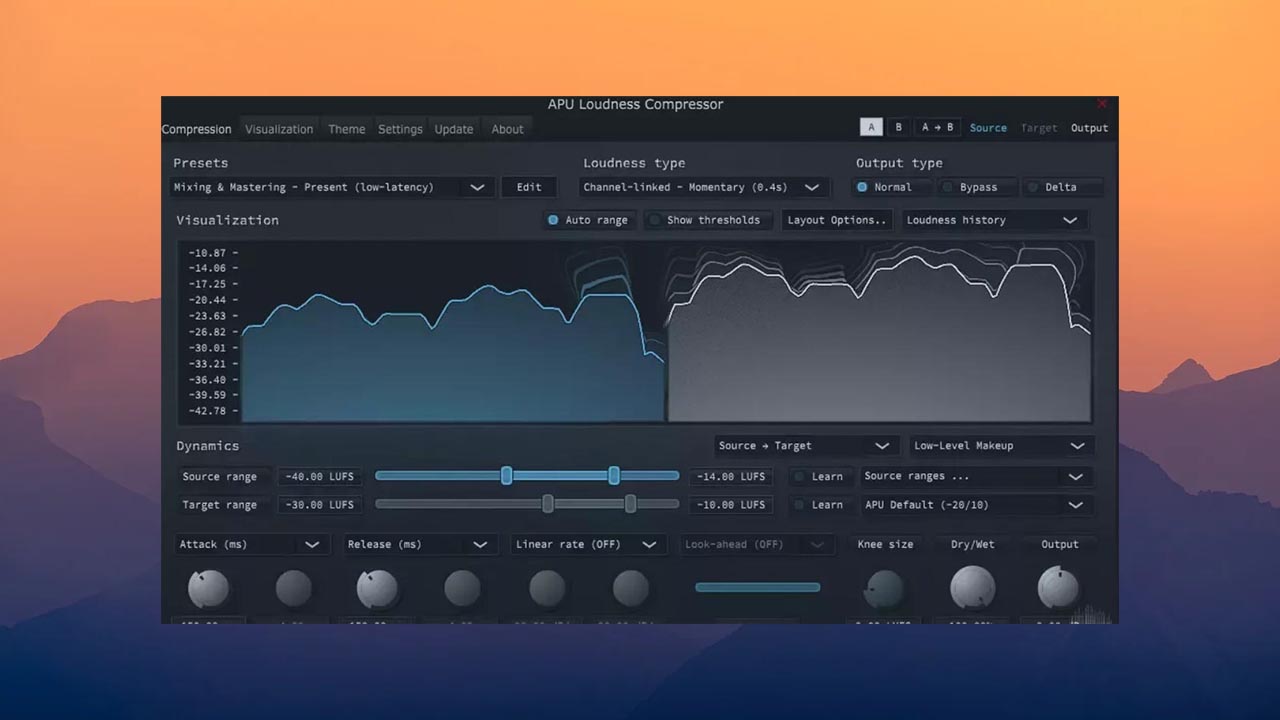
The APU Loudness Compressor is a compressor/expander designed to support modern loudness metering methods (LUFS, True Peak). This means the compression curve is based on LUFS measurements rather than RMS or peak values. Since LUFS is a more accurate measure of loudness, the resulting compression is very transparent, making it particularly suitable for mastering and post-production. The compressor can also operate in a more traditional mode, using RMS and peak values, so you can achieve both.
Additional information:
By default, the compressor operates using “source range” and “target range” instead of threshold and ratio controls. You can also enable traditional threshold and ratio controls if desired. The drop-down menu located in the upper right corner of the Compressor Dynamics section allows you to switch between these operating modes and others, such as expander, limiter, and so on.
When “learn” mode is enabled, the compressor automatically adjusts the source or target range to match the source material. This is a great way to get started with the compressor, and can be used as a starting point for further fine-tuning.
Check to see if it suits your workflow. If you have any questions or suggestions, please feel free to contact us using the “Contact the Developer” button on this website.
Loudness Adjustment Options:
One of the key features of this compressor is its support for various loudness adjustment types. The compressor’s detection circuit can be configured to use either LUFS or traditional units (RMS, peak). You can also split or link channels, which is especially useful for multi-channel audio formats such as Dolby Atmos®.
The compressor detection circuit can be configured to use any of the following loudness types:
Instantaneous:
Instantaneous mode measures LUFS over a short period of time (400 ms), which is useful for processing the dynamics of sound at any given moment. This mode is responsive yet transparent, making it a suitable default mode for the compressor. K-weighting and channel weighting are applied to the compressor detection circuit, which improves perceptual accuracy.
Instantaneous LUFS
Short-Term: Short-Term LUFS measurement with a longer dwell time (3 seconds), which is useful for processing large-scale sound dynamics. Due to the longer dwell time, this mode is less sensitive than Instantaneous, but it can be useful for adjusting the overall picture of sound dynamics. K-weighting and channel weighting are applied in the same way as with Instantaneous metering.
Short-Term LUFS
RMS loudness metering types use a sliding time interval of 300 ms. RMS is a traditional loudness metering method that is a good first-order approximation of perceived loudness. This mode does not use K-weighting or channel weighting in the compressor detection circuitry, giving it a more traditional character.
RMS
True Peak Loudness metering types are similar to traditional peak loudness metering, but are more accurate because they take into account intersample peaks. These metering methods use a time interval equal to the specified block size (1 ms by default). This mode is characterized by a fast response speed, making it suitable for very fast attack and release times.
True Peak
Peak Loudness metering types are a standard peaking circuit operating over a time interval equal to the specified block size (1 ms by default). This is another traditional compressor-style metering method. Technically, this mode is even slightly more sensitive than True Peak, but it is less accurate because it does not take into account intersample peaks.

![WA Production Mixboss 1.0.0 VST, VST3, AAX x86 x64 [2025] BUBBiX](https://vsttorrent.top/wp-content/uploads/2026/03/WA-Production-Mixboss-1.0.0-VST-VST3-AAX-x86-x64-2025-BUBBiX-445x265.jpg "WA Production Mixboss 1.0.0 VST, VST3, AAX x86 x64 [2025] BUBBiX")
![Arturia Analog Lab Pro V v5.11.2 [CE-VR] STANDALONE, VSTi, VSTi3, AAX x64 [April 24, 2025]](https://vsttorrent.top/wp-content/uploads/2026/03/Arturia-Analog-Lab-Pro-V-v5.11.2-CE-VR-STANDALONE-VSTi-VSTi3-AAX-x64-April-24-2025-445x265.jpg "Arturia Analog Lab Pro V v5.11.2 [CE-VR] STANDALONE, VSTi, VSTi3, AAX x64 [April 24, 2025]")